Sumanene-based triazole-linked receptors
Designing molecular receptors featuring the bowl-shaped sumanene motif for detecting metal cations constitutes an emerging field of applied supramolecular chemistry of this buckybowl. In this work, we successfully synthesized a new class of sumanene-based receptors, whose key structural feature was the presence of two or three sumanene units linked via 1,2,3-triazole skeletons generated in a 1,3-dipolar cycloaddition reaction (click chemistry approach). It was found that the designed compounds detect metal cations in solution (spectrofluorometric studies), as well as in heterogeneous systems (polymeric membranes of potentiometric sensors). In terms of optical studies in solution, the title molecules exhibited fluorescence quenching behaviours upon addition of metal cations, with Stern–Volmer constant values at the level of 106 M−1. The spectrofluorometric and potentiometric results were in good agreement, revealing the preferential binding of lithium (Li+), caesium (Cs+), or copper(II) (Cu2+) cations, depending on the receptor structure. Density functional theory (DFT) computational studies were also performed on the structure and receptor properties of the title molecules. The results indicate attractive possibilities for the design of novel organic materials based on the sumanene scaffold and the ability to tune the properties of sumanene-based receptors for recognition of different metal cations.

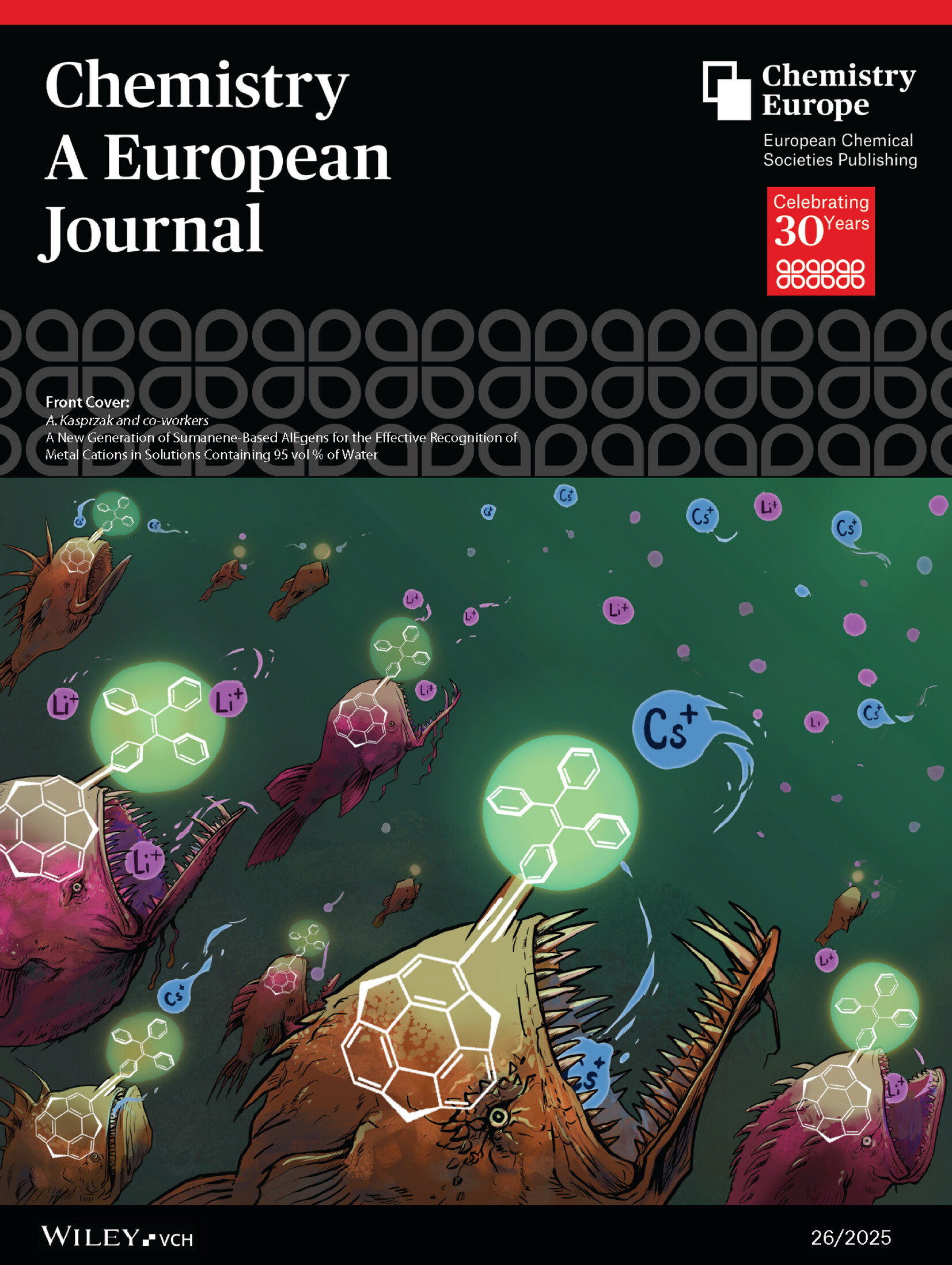
A New Generation of Sumanene-Based AIEgens for the Effective Recognition of Metal Cations in Solutions Containing 95 vol % of Water
In recent years, the application of sumanene derivatives for the optical detection of metal cations was demonstrated. Unfortunately, known sumanene-based receptors enable the detection process in purely organic solutions or in aqueous media containing not lower than 50 vol % of organic solvent. Designing easy-to-synthesize sumanene-based optical receptors able to effectively recognize metal cations in aqueous solutions containing a slight volume fraction of organic solvent remained an important and vital challenge. In this work, we show that water-insoluble sumanene receptors composed of only carbon and hydrogen atoms enable the effective detection of cesium (Cs+)
or lithium (Li+) cations in solutions containing 95 vol % of water. Their key feature is related to the exhibition of an aggregation-induced emission (AIE) effect. We discovered that the designed sumanene receptors exhibit excellent detection parameters expressed by Stern-Volmer constant values at the level from 108 to 1010 M−1. This work also shows that by simple modification of the sumanene receptor structure, it is possible to drastically change its detection preference from large Cs+ cations to small Li+ cations. The highest sensitivity of the designed receptors was concluded for Na+ or Li+, depending on the receptor structure. This work opens new avenues in designing sumanene-based optical receptors.
Metal cations recognition by bowl-shaped N-pyrrolic polycyclic aromatic hydrocarbons
Bowl-shaped, nitrogen-doped polycyclic aromatic hydrocarbons were examined for the first time as molecular receptors for the recognition of metal cations. Potentiometric and spectrofluorimetric assays, supported with density functional theory computations, revealed that the title compounds recognise metal cations with a special focus on caesium (Cs+) cations.


Sumanene–carbazole conjugate with push–pull structure and its chemoreceptor application
The first-of-its-kind tetra-substituted sumanene derivative, featuring the push–pull chromophore architecture, has been successfully designed. The inclusion of both strong electron-withdrawing (CF3)
and electron-donating (carbazole) moieties in this buckybowl compound has enhanced the charge transfer characteristics of the molecule. This enhancement was supported by ultraviolet-visible (UV-Vis) and emission spectra analyses along with density functional theory (DFT) calculations. The application of the title sumanene–carbazole push–pull chromophore as a selective recognition material for cesium cations (Cs+) was also presented. The title compound exhibited effective and selective Cs+-trapping ability, characterized by a high apparent binding constant value (at the level of 105) and a low limit of detection (0.09–0.13 μM). Owing to the tuned optical properties of the title push–pull chromophore, this study marks the first time in sumanene-tethered chemoreceptor chemistry where efficient tracking of Cs+ binding was possible with both absorption and fluorescence spectroscopies. This work introduces a new approach toward tuning the structure of bowl-shaped optical chemoreceptors.
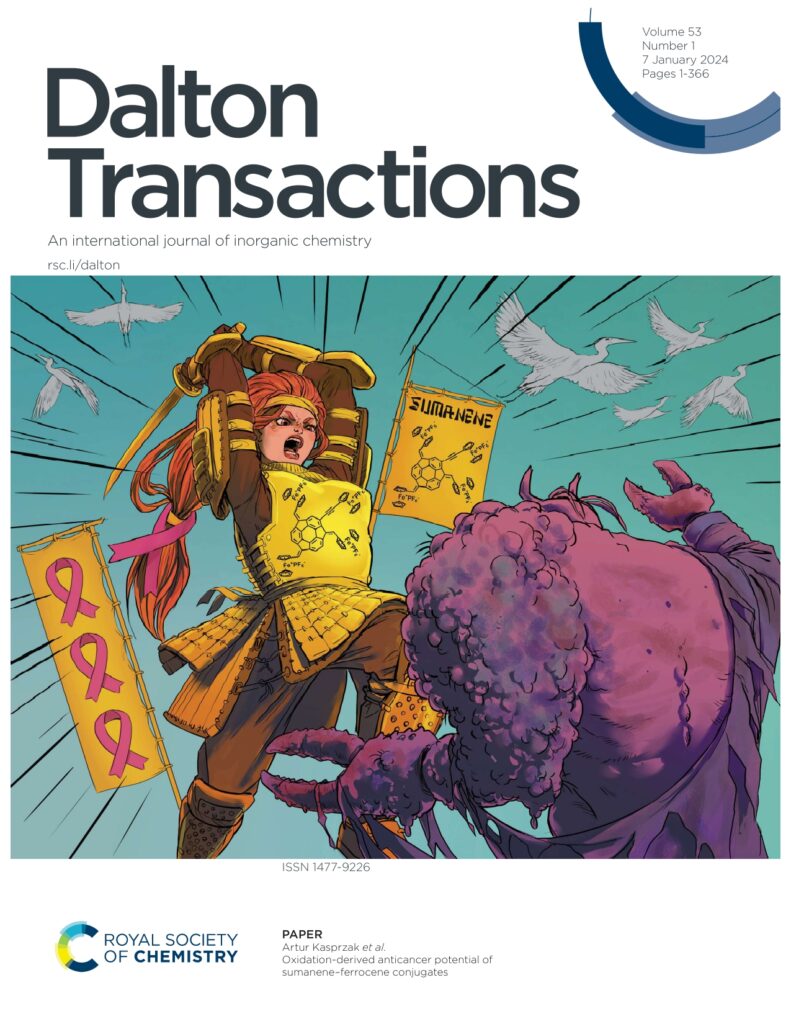
Oxidation-derived anticancer potential of sumanene–ferrocene conjugates
An effective synthetic protocol towards the oxidation of sumanene–ferrocene conjugates bearing one to four ferrocene moieties has been established. The oxidation protocol was based on the transformation of FeII from ferrocene to FeIII-containing ferrocenium cations by means of the treatment of the title organometallic buckybowls with a mild oxidant. Successful isolation of these ferrocenium-tethered sumanene derivatives gave rise to the biological evaluation of the first, buckybowl-based anticancer agents, as elucidated by in vitro assays with human breast adenocarcinoma cells (MDA-MB-231) and embryotoxicity trials in zebrafish embryos supported with in silico toxicology studies. The designed ferrocenium-tethered sumanene derivatives featured attractive properties in terms of their use in cancer treatments in humans. Ferrocenium-tethered sumanene derivatives exhibited potential towards the generation of reactive oxygen species (ROS), responsible for biological damage to the cancer cells, with the most efficient generation of the tetra-ferrocenium sumanene derivative.

A sumanene-containing magnetic nanoadsorbent for the removal of caesium salts from aqueous solutions
Sumanene was covalently immobilised onto the surface of cobalt nanomagnets to obtain a magnetic nanoadsorbent. This nanoadsorbent was specifically designed to efficiently and selectively remove caesium (Cs) salts from aqueous solutions. The nanoadsorbent’s application potential was evidenced by the removal of Cs from model aqueous solutions, simulating the concentrations of radioactive 137Cs in the environment. Additionally, Cs was effectively removed from aqueous wastes generated by routine chemical processes, including those used in drug synthesis.
Fast, solvent-free synthesis of ferrocene-containing organic cages via dynamic covalent chemistry in the solid state
A simple, solvent-free synthetic protocol towards the synthesis of organic self-assembled macromolecules has been established. By employing mechanochemistry using glassware readily available to every organic chemist, we were able to synthesise three novel organic cage compounds exemplarily and to speed up the synthesis of a ferrocene-containing macrocycle by a factor of 288 compared to the solution-based synthesis. The structural investigation of the newly synthesised cages revealed different modes of connectivity from using ferrocene-containing aldehydes caused by the free rotation of the cyclopentadienyl units against each other. By extending the facile solvent-free synthesis to ball-milling, even compounds that show lower reactivity could be employed in the dynamic covalent formation of organometallic cage compounds. The presented protocol gives access to otherwise inaccessible structures, speeds up general synthetic workflows, and simultaneously reduces the environmental impact of supramolecular syntheses.


Tris(ferrocenylmethidene)sumanene: synthesis, photophysical properties and applications for efficient caesium cation recognition in water
The synthesis of a sumanene derivative bearing three ferrocenyl substituents is presented. This conjugated compound is solution-processable, shows red-light emission with high fluorescence quantum yield and can be used for the construction of the first buckybowl-based sensor for the selective and effective recognition of caesium cations (Cs+) in aqueous solution.
Site-selective cation–π interaction as a way of selective recognition of the caesium cation using sumanene-functionalized ferrocenes
The first sumanene–ferrocene probes for efficient and selective caesium cation (Cs+) recognition are reported. The working mechanism of the sumanene moiety as the sensing unit was based on the site-selective cation–π interaction in its neutral state. The interactions with Cs+ were characterized by high association constant values together with low limits of detection.